Knight circa 1290 to 1330 AD
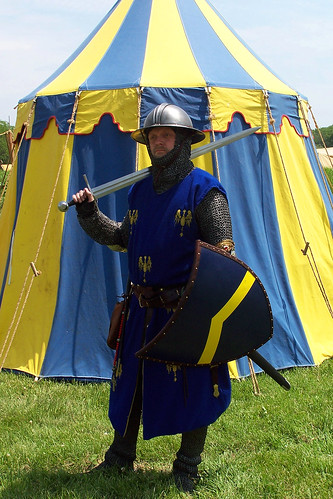
Image by One lucky guy
Posing outside the pavilion of some friends that happens to match my colors by no small coincidence.
Despite my forboding about the weather, the heavens smiled upon us this past Saturday. Perfect weather really, so I got a chance to go full-bore on the kit except for the great helm. I really enjoy reenactment events. Nobody cares if you draw your sword and wield it for patrons as I am doing in this photo.
This comment on reenactment events may seem rhetorical. My point is to contrast them with Renaissance Festivals where security guards affectionately known as "the white shirts" will descend upon you with walkie-talkies blaring should you dare to draw steel within the festival grounds. I have been chastized plenty in the past. Yes, I am a bad boy; always wanting to whip my sword out:)
That paternoster with the coral red beads on my belt is the latest addition to the kit; the medieval ancestor of modern rosary beads that would have been worn as display of religious devotion by all classes in the middle ages.
]]>
by Charlie Day DaytimeStudios
Question by Casandra: what kind of bra do i wear under my corset?
my boyfriend bought me a corset offline to wear to the Renaissance fair and it doesn’t have a built in bra. i’ve tried a strapless bra, but i still look flat chested. i don’t know what to look for.help?
Best answer:
Answer by Kassandra
Did your boyfriend buy a corset or a bodice? They are 2 different things.
With a corset, specially if it is an overbust, you do not need a bra, as the busk and the stays will push up your breasts. If it is an underbust, you may or may not use a bra, but I recommend that you do.
With a bodice, you need a bra because bodices have no support system of their own. Any bra that you usually wear will suffice.
“i still look flat chested”. Sorry to say this, but if your breast are small to begin with, a corset or a bodice will not make you look like Pam Anderson.
Give your answer to this question below!
]]>The Annunciation of the Virgin Deal

Image by failing_angel
Mixed material tapestry by Grayson Perry
Part of ‘The Vanity of Small Differences’ – a series of 6 tapestries (200x400cm)
In The Vanity of Small Differences Grayson Perry explores his fascination with taste and the visual story it tells of our interior lives in a series of six tapestries at Victoria Miro and three programmes, All in the Best Possible Taste with Grayson Perry, for Channel 4. The artist goes on a safari amongst the taste tribes of Britain, to gather inspiration for his artworks, literally weaving the characters he meets into a narrative partly inspired by Hogarth’s A Rake’s Progress.
Grayson Perry comments: "The tapestries tell the story of class mobility, for I think nothing has as strong an influence on our aesthetic taste as the social class in which we grow up. I am interested in the politics of consumerism and the history of popular design but for this project I focus on the emotional investment we make in the things we choose to live with, wear, eat, read or drive. Class and taste run deep in our character – we care. This emotional charge is what draws me to a subject".
Perry has always worked with traditional media; ceramics, cast iron, bronze, printmaking and tapestry. He is interested in how each historic category of object accrues over time intellectual and emotional baggage. Tapestry is the art form of grand houses: depicting classical myths, historical and religious scenes and epic battles. In this series of works Perry plays with idea of using this ancient allegorical art to elevate the commonplace dramas of modern British life.
The artist’s primary inspiration was A Rake’s Progress (1732 -33) by William Hogarth, which in eight paintings tells the story of Tom Rakewell, a young man who inherits a fortune from his miserly father, spends it all on fashionable pursuits and gambling, marries for money, gambles away a second fortune, goes to debtors’ prison and dies in a madhouse.
The Vanity of Small Differences tells the story of the rise and demise of Tim Rakewell and is composed of characters, incidents and objects Perry encountered on journeys through Sunderland, Tunbridge Wells and The Cotswolds. Hogarth has long been an influence on Perry’s works, his Englishness, his robust humour and his depiction of, in his own words, ‘modern moral subjects’. The secondary influence comes from Perry’s favourite form of art, early Renaissance painting.
Each of the six images, to a greater or lesser extent, pays homage to a religious work. Including Masaccio’s Expulsion from the Garden of Eden, Matthias Grünewald’s Isenheim Altarpiece, Rogier Van de Weyden’s Lamentation and three different paintings of The Annunciation by Carlo Crivelli, Grünewald and Robert Campin. The images also reference the pictorial display of wealth and status in The Arnolfini Portrait by Jan Van Eyck and Mr & Mrs Andrews by Thomas Gainsborough. Woven into each tapestry are snatches of text, each one in the voice of a participant in the scene illustrated. Each image also features a small dog, reminiscent of Hogarth’s beloved pug, Trump.
The Annunciation of the Virgin Deal, 2012
Tim is relaxing with his family in the kitchen of his large, rural (second) home. His business partner has just told him he is now an extremely wealthy man as they have sold their software business to Richard Branson.
On the table is a still life demonstrating the cultural bounty of his affluent lifestyle. His parents-in-law read and his elder child plays on the rug. Tim dandles his baby while his wife tweets.
This image includes references to three different paintings of the Annunciation, by Carlo Crivelli (the vegetables), Matthias Grunewald (his colleague’s expression) and Robert Campin (the jug of lilies). The convex mirror and discarded shoes are reminders of that great pictorial display of wealth and status, The Arnolfini Portrait, by Jan Van Eyck.
[Initial text from Victoria Miro Gallery, description of each piece by Grayson Perry from C4 website]
Previously a furniture factory, the Victoria Miro Gallery lies just off City Road. The garden at the back also holds a reclaimed part of Regent’s Canal at Wenlock Basin.
The Annunciation of the Virgin Deal

Image by failing_angel
Mixed material tapestry by Grayson Perry
Part of ‘The Vanity of Small Differences’ – a series of 6 tapestries (200x400cm)
In The Vanity of Small Differences Grayson Perry explores his fascination with taste and the visual story it tells of our interior lives in a series of six tapestries at Victoria Miro and three programmes, All in the Best Possible Taste with Grayson Perry, for Channel 4. The artist goes on a safari amongst the taste tribes of Britain, to gather inspiration for his artworks, literally weaving the characters he meets into a narrative partly inspired by Hogarth’s A Rake’s Progress.
Grayson Perry comments: "The tapestries tell the story of class mobility, for I think nothing has as strong an influence on our aesthetic taste as the social class in which we grow up. I am interested in the politics of consumerism and the history of popular design but for this project I focus on the emotional investment we make in the things we choose to live with, wear, eat, read or drive. Class and taste run deep in our character – we care. This emotional charge is what draws me to a subject".
Perry has always worked with traditional media; ceramics, cast iron, bronze, printmaking and tapestry. He is interested in how each historic category of object accrues over time intellectual and emotional baggage. Tapestry is the art form of grand houses: depicting classical myths, historical and religious scenes and epic battles. In this series of works Perry plays with idea of using this ancient allegorical art to elevate the commonplace dramas of modern British life.
The artist’s primary inspiration was A Rake’s Progress (1732 -33) by William Hogarth, which in eight paintings tells the story of Tom Rakewell, a young man who inherits a fortune from his miserly father, spends it all on fashionable pursuits and gambling, marries for money, gambles away a second fortune, goes to debtors’ prison and dies in a madhouse.
The Vanity of Small Differences tells the story of the rise and demise of Tim Rakewell and is composed of characters, incidents and objects Perry encountered on journeys through Sunderland, Tunbridge Wells and The Cotswolds. Hogarth has long been an influence on Perry’s works, his Englishness, his robust humour and his depiction of, in his own words, ‘modern moral subjects’. The secondary influence comes from Perry’s favourite form of art, early Renaissance painting.
Each of the six images, to a greater or lesser extent, pays homage to a religious work. Including Masaccio’s Expulsion from the Garden of Eden, Matthias Grünewald’s Isenheim Altarpiece, Rogier Van de Weyden’s Lamentation and three different paintings of The Annunciation by Carlo Crivelli, Grünewald and Robert Campin. The images also reference the pictorial display of wealth and status in The Arnolfini Portrait by Jan Van Eyck and Mr & Mrs Andrews by Thomas Gainsborough. Woven into each tapestry are snatches of text, each one in the voice of a participant in the scene illustrated. Each image also features a small dog, reminiscent of Hogarth’s beloved pug, Trump.
The Annunciation of the Virgin Deal, 2012
Tim is relaxing with his family in the kitchen of his large, rural (second) home. His business partner has just told him he is now an extremely wealthy man as they have sold their software business to Richard Branson.
On the table is a still life demonstrating the cultural bounty of his affluent lifestyle. His parents-in-law read and his elder child plays on the rug. Tim dandles his baby while his wife tweets.
This image includes references to three different paintings of the Annunciation, by Carlo Crivelli (the vegetables), Matthias Grunewald (his colleague’s expression) and Robert Campin (the jug of lilies). The convex mirror and discarded shoes are reminders of that great pictorial display of wealth and status, The Arnolfini Portrait, by Jan Van Eyck.
[Initial text from Victoria Miro Gallery, description of each piece by Grayson Perry from C4 website]
Previously a furniture factory, the Victoria Miro Gallery lies just off City Road. The garden at the back also holds a reclaimed part of Regent’s Canal at Wenlock Basin.
The Annunciation of the Virgin Deal

Image by failing_angel
Mixed material tapestry by Grayson Perry
Part of ‘The Vanity of Small Differences’ – a series of 6 tapestries (200x400cm)
In The Vanity of Small Differences Grayson Perry explores his fascination with taste and the visual story it tells of our interior lives in a series of six tapestries at Victoria Miro and three programmes, All in the Best Possible Taste with Grayson Perry, for Channel 4. The artist goes on a safari amongst the taste tribes of Britain, to gather inspiration for his artworks, literally weaving the characters he meets into a narrative partly inspired by Hogarth’s A Rake’s Progress.
Grayson Perry comments: "The tapestries tell the story of class mobility, for I think nothing has as strong an influence on our aesthetic taste as the social class in which we grow up. I am interested in the politics of consumerism and the history of popular design but for this project I focus on the emotional investment we make in the things we choose to live with, wear, eat, read or drive. Class and taste run deep in our character – we care. This emotional charge is what draws me to a subject".
Perry has always worked with traditional media; ceramics, cast iron, bronze, printmaking and tapestry. He is interested in how each historic category of object accrues over time intellectual and emotional baggage. Tapestry is the art form of grand houses: depicting classical myths, historical and religious scenes and epic battles. In this series of works Perry plays with idea of using this ancient allegorical art to elevate the commonplace dramas of modern British life.
The artist’s primary inspiration was A Rake’s Progress (1732 -33) by William Hogarth, which in eight paintings tells the story of Tom Rakewell, a young man who inherits a fortune from his miserly father, spends it all on fashionable pursuits and gambling, marries for money, gambles away a second fortune, goes to debtors’ prison and dies in a madhouse.
The Vanity of Small Differences tells the story of the rise and demise of Tim Rakewell and is composed of characters, incidents and objects Perry encountered on journeys through Sunderland, Tunbridge Wells and The Cotswolds. Hogarth has long been an influence on Perry’s works, his Englishness, his robust humour and his depiction of, in his own words, ‘modern moral subjects’. The secondary influence comes from Perry’s favourite form of art, early Renaissance painting.
Each of the six images, to a greater or lesser extent, pays homage to a religious work. Including Masaccio’s Expulsion from the Garden of Eden, Matthias Grünewald’s Isenheim Altarpiece, Rogier Van de Weyden’s Lamentation and three different paintings of The Annunciation by Carlo Crivelli, Grünewald and Robert Campin. The images also reference the pictorial display of wealth and status in The Arnolfini Portrait by Jan Van Eyck and Mr & Mrs Andrews by Thomas Gainsborough. Woven into each tapestry are snatches of text, each one in the voice of a participant in the scene illustrated. Each image also features a small dog, reminiscent of Hogarth’s beloved pug, Trump.
The Annunciation of the Virgin Deal, 2012
Tim is relaxing with his family in the kitchen of his large, rural (second) home. His business partner has just told him he is now an extremely wealthy man as they have sold their software business to Richard Branson.
On the table is a still life demonstrating the cultural bounty of his affluent lifestyle. His parents-in-law read and his elder child plays on the rug. Tim dandles his baby while his wife tweets.
This image includes references to three different paintings of the Annunciation, by Carlo Crivelli (the vegetables), Matthias Grunewald (his colleague’s expression) and Robert Campin (the jug of lilies). The convex mirror and discarded shoes are reminders of that great pictorial display of wealth and status, The Arnolfini Portrait, by Jan Van Eyck.
[Initial text from Victoria Miro Gallery, description of each piece by Grayson Perry from C4 website]
Previously a furniture factory, the Victoria Miro Gallery lies just off City Road. The garden at the back also holds a reclaimed part of Regent’s Canal at Wenlock Basin.
]]>“Copper Celt”

Image by Elif Ayiter/Alpha Auer/…./
After a long absence we are back with "Copper Celt" designed by Grapho: The medieval armor which was largely used for the attachments is a full permissions item by Wyld Magic which Grapho has minutely retextured as well as modified and added onto. This is a unisex outfit with skins and texture leotards for both sexes. All the attachments (and believe me there are a lot of them!) can be worn by men and women alike, although some scaling up may be called for where men are concerned. The ladies also get an extra skirt btw…
Visit alpha.tribe at Klein:
slurl.com/secondlife/Klein/55/116/63
“Copper Celt”

Image by Elif Ayiter/Alpha Auer/…./
After a long absence we are back with "Copper Celt" designed by Grapho: The medieval armor which was largely used for the attachments is a full permissions item by Wyld Magic which Grapho has minutely retextured as well as modified and added onto. This is a unisex outfit with skins and texture leotards for both sexes. All the attachments (and believe me there are a lot of them!) can be worn by men and women alike, although some scaling up may be called for where men are concerned. The ladies also get an extra skirt btw…
Visit alpha.tribe at Klein:
slurl.com/secondlife/Klein/55/116/63
Hope making an attempt to appear significant – that is hopeless (IMG_4555a)

Impression by Alaskan Dude
I experienced the opportunity to shoot with the pretty, entertaining, bubbly, very photogenic, and sweet Hope and her spectacular companion Allison with equally donning chain mail. I can not believe how blessed I am!
There is a chain mail shop at the Texas Renaissance Good during the working day they sponsor a chain mail trend demonstrate – it is a photographer’s delight. Doing work with beautiful types this kind of as Hope and Allison is absolutely a single on the highlights of the Reasonable. I hope to be ready to shoot with each of them once again at the 2012 TRF!
Two of Texas finest chain mail versions (IMG_4578a)

Impression by Alaskan Dude
I experienced the likelihood to shoot with the lovely, exciting, bubbly, extremely photogenic, and sweet Hope and her beautiful companion Allison with both donning chain mail. I can’t think how fortunate I am!
There is a chain mail shop at the Texas Renaissance Honest for the duration of the day they sponsor a chain mail style display – it is a photographer’s delight. Operating with pretty types such as Hope and Allison is undoubtedly 1 on the highlights of the Fair. I hope to be ready to shoot with equally of them once more at the 2012 TRF!
]]>NYC – Metropolitan Museum of Art – Triumph of Fame

Image by wallyg
The Triumph of Fame; (verso) Impresa of the Medici Family and Arms of the Medici and Tornabuoni Families
birth tray, ca. 1449
Giovanni di Ser Giovanni (called Scheggia) (Italian, Florentine, 14061486)
Tempera, silver, and gold on wood; Overall, with engaged frame, diameter 36 1/2 in. (92.7 cm); recto, painted surface, diameter 24 5/8 in. (62.5 cm); verso, painted surface, diameter 29 5/8 in. (75.2 cm)
This imposing object, a commemorative birth tray (desco da parto), was commissioned to celebrate the birth of Lorenzo de’ Medici, known to posterity as Lorenzo the Magnificent (14491492). Lorenzo was the most celebrated ruler of his day as well as an important poet and a major patron of the arts; his name is synonymous with the Renaissance.
The imagery is taken from Boccaccio’s "L’Amorosa visione" as well as Petrarch’s "Trionfi". Knights extend their hands in allegiance to an allegorical figure of Fame, who holds a sword and winged cupid (symbolic of celebrity through arms and love). Winged trumpets sound Fame’s triumph. Captives are bound to the elaborate support. The three-colored ostrich feathers around the rim are a heraldic device of Lorenzo’s father, Piero de’ Medici.
Painted by the younger brother of Masaccio, this is an object of unique historical importance. It was kept by Lorenzo in his private quarters in the Medici palace in Florence and was acquired in the early years of the nineteenth century by Alexis-François Artaud de Montor, one of the earliest collectors of early Italian painting. Later it belonged to Thomas Jefferson Bryan, the first New Yorker to collect early Italian art.
The reverse of most surviving birth trays shows an image of a child. This one is decorated with the armorial device of Lorenzo the Magnificent’s father, Piero de’ Medici: a diamond ring with three ostrich feathers and a banderole with the motto SEMPER (forever). The device, now much worn and oxidized, may signify eternal faithfulness and strength. The Medici arms are in the upper left, those of the Tornabuoni are in the upper right. Piero de’ Medici married Lucrezia Tornabuoni in 1444 and their first son, Lorenzo, was born in 1449.
The tradition of commissioning circular trays or salvers to commemorate a birth derived from the custom of presenting sweetmeats to the new mother. Painted for the most famous figure of the Italian Renaissance, this is the largest and most opulent birth tray known, and one of the few to survive with its original engaged molding.
Purchase in memory of Sir John Pope-Hennessy: Rogers Fund, The Annenberg Foundation, Drue Heinz Foundation, Annette de la Renta, Mr. and Mrs. Frank E. Richardson, and The Vincent Astor Foundation Gifts, Wrightsman and Gwynne Andrews Funds, special funds, and Gift of the children of Mrs. Harry Payne Whitney, Gift of Mr. and Mrs. Joshua Logan, and other gifts and bequests, by exchange, 1995 (1995.7)
**
The Metropolitan Museum of Art‘s permanent collection contains more than two million works of art from around the world. It opened its doors on February 20, 1872, housed in a building located at 681 Fifth Avenue in New York City. Under their guidance of John Taylor Johnston and George Palmer Putnam, the Met’s holdings, initially consisting of a Roman stone sarcophagus and 174 mostly European paintings, quickly outgrew the available space. In 1873, occasioned by the Met’s purchase of the Cesnola Collection of Cypriot antiquities, the museum decamped from Fifth Avenue and took up residence at the Douglas Mansion on West 14th Street. However, these new accommodations were temporary; after negotiations with the city of New York, the Met acquired land on the east side of Central Park, where it built its permanent home, a red-brick Gothic Revival stone "mausoleum" designed by American architects Calvert Vaux and Jacob Wrey Mold. As of 2006, the Met measures almost a quarter mile long and occupies more than two million square feet, more than 20 times the size of the original 1880 building.
In 2007, the Metropolitan Museum of Art was ranked #17 on the AIA 150 America’s Favorite Architecture list.
The Metropolitan Museum of Art was designated a landmark by the New York City Landmarks Preservation Commission in 1967. The interior was designated in 1977.
National Historic Register #86003556
Portrait of King Henry VIII 1491-1547 c.1590 1590c.
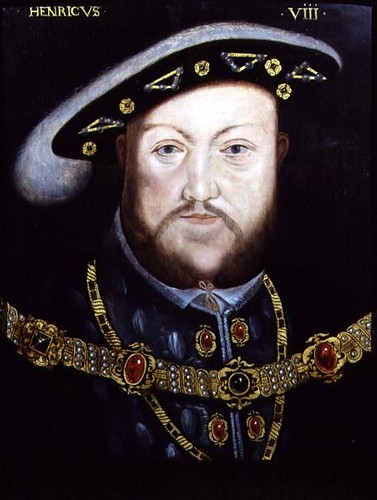
Image by lisby1
This portrait is one of a number of similar ”corridor” works taken from Hans Holbein”s momentous picture of Henry VIII executed in 1537. The image of the King, initially devised for a wall painting in the Privy Chamber at Whitehall featured the monarch in a renaissance pose that derived from Donatello”s depiction of St. George. It is believed that at the time of its inception this representation of the King was intended for duplication and utilisation as an official image. Certainly it has endured as one of the most distinguished portraits of any royal sitter.
Our bust-length version of Henry VIII features the commanding, head-on visage of the monarch wearing a jewel-studded black and blue doublet and plumed cap. Between his squared shoulders falls a decorative chain as well as one which features the letter ”H”. As this image was one which was reproduced frequently, stylistic variations as well as alterations in the King’s dress and jewellery feature commonly and serve to accent the individuality of each likeness. A further enhancing feature of this particular edition is in the visibility of the artist’s technique, notably the sketch lines around the eyes and mouth.
Corridor portraits of this size and style were designed for display in the Long Galleries of England”s manor houses. Pictures similar to our image of Henry VIII were commissioned for corridor sets at Boughton, Longleat, Helmingham Hall and Ingatestone.
Day 3: Shivali Sahay

Image by chicagopublicmedia
A model poses in a dress designed by Shivali Sahay for her collection "Curtains of Renaissance" on Day 3 of the Blender’s Pride: Bangalore Fashion Week: Winter Festive 2012, on July 28. Sahay says hers designs are "practical dresses, jumpsuits and work wear for the women of Modern Era which retain the nostalgic intricacies of our dear old Renaissance."
(Photo courtesy of Pepper India PR)
]]>74/365: Reflective

Image by khowaga1
74/365: Reflection. March 16, 2010.
In the Madrassa of Sultan Hassan in the old city. This is the sister of our Egyptologist tour guide from the day before, and she doesn’t normally wear a scarf — I had borrowed a bunch from a friend and distributed them to those who needed them.
Sunny Spofforth
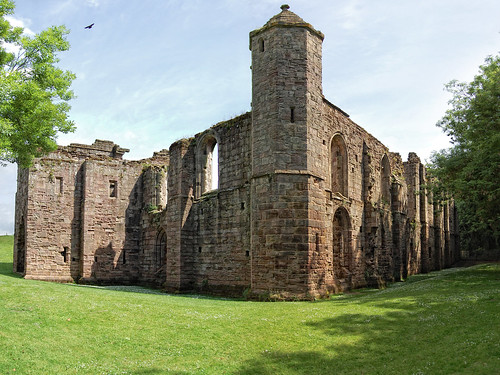
Image by tj.blackwell
A shot taken from the north side of Spofforth Castle. In 1067, William de Percy came to this country from Normandy. Being a favourite of William the Conquerer, he was granted no less than eighty six Lordships in Yorkshire, including Spofforth. As the centuries wore on, the Percy family obtained much power and influence in the north-east, which meant the importance of Spofforth as a residence declined. The Percy estates were confiscated following the rebellion of Henry, 1st Earl of Northumberland against King Henry IV in 1408. They were later restored but were lost again in 1461 during the Wars of the Roses. Although Spofforth returned to the family, it lay neglected for nearly a hundred years until another Henry, Lord Percy, restored it in 1559. Records suggest that the castle was last inhabited in 1604. It was finally reduced to ruins during the Civil War when its owners backed the losing side. The victors declared ‘Free Quarry’ on the site – it meant that locals were allowed to come and plunder the stone for their own use. As a result, many buildings in the locality contain elements of the pink sandstone which were once a part of the castle.

by Alaskan Dude
Question by karu69: What do i wear to a renaissance fair?
my friend asked me to a ren. festival and i said yes to see what it is like there, but i dont know what to wear to it because… well i dont know about you but i dont have any medieval clothes in my closet
Please help! the fair is this sunday :O
Best answer:
Answer by Boba Fett
“spending a week in the renaissance fair, got my name on my underwear”….. Ha Ha, u know the song, white and nerdy??? Ha Ha!
What do you think? Answer below!
]]>
by Alaskan Dude
Concern by Gloomy Birdy: Why do some lady use a coon tail tucked into the back again of her skirt at a renaissance fair?
I was not long ago at the ren fest in Shakopee MN, and noticed many females with raccoon tails tucked in the back of their skirts. I have been unable to find it this has any importance. Does any person know? Many thanks so significantly!
Greatest answer:
Solution by tori_lynn_1904
im asking yourself wassup with that too
Include your personal response in the responses!
]]>An Important Roman (Domitianic) Green Porphyry Sphinx of an Egyptian Queen

Image by Ancient Art
A GREEN PORPHYRY SPHINX OF AN EGYPTIAN QUEEN,
ROMAN IMPERIAL, CIRCA 1ST CENTURY A.D, PROBABLY REIGN OF DOMITIAN, A.D. 81-96
couchant on a rectangular base rounded at the back, the tail curved around the right hindquarter, and wearing a broad beaded collar and centrally divided ribbed wig with voluted curls surmounted by the vulture headdress, her face with smiling mouth and long contoured eyebrows in relief.
MEASUREMENTS
height 19 1/2 in. 49.5 cm.; length 37 1/2 in. 95.2 cm.
PROVENANCE
Most likely from the sanctuary of the Egyptian gods, the Iseum Campense, on the Campus Martius in Rome
Hagop Kevorkian, New York, probably acquired before World War II
Kevorkian Foundation, New York (Sotheby’s, London, November 13th, 1975, no. 180)
K.J. Hewett, London
James J. Freeman, London, 1979
LITERATURE AND REFERENCES
Anne Roullet, Egyptian and Egyptianizing Monuments of Imperial Rome, Leiden, 1972, p. 132, no. 277, fig. 289
Maarten J. Vermaseren, Margreet B. de Boer, and T.A. Eldridge, eds., Hommages à Maarten J. Vermaseren: recueil d’études offert par les auteurs de la série Études préliminaires aux religions orientales dans l’Empire romain à Maarten J. Vermaseren à l’occasion de son soixantième anniversaire le 7 avril 1978 (Etudes préliminaires aux religions orientales dans l’Empire romain, vol. 68), Leiden, 1977, p. 645
Giorgio Carredu, Museo Barracco di scultura antica. La collezione egizia, Rome, 1985, p. 19
Katja Lembke, Das Iseum Campense in Rom: Studie über den Isiskult unter Domitian (Archäologie und Geschichte, vol. 3), Heidelberg, 1994, p. 242, KAT. E 45, pl. 34,1
John Cherry, Mythical Beasts, London, 1995, pp. 120-121
Brian Anthony Curran, Ancient Egypt and Egyptian Antiquities in Italian Renaissance Art and Culture, doctoral dissertation, Princeton University, 1997, pp. 86-87, n. 62
Kim J. Hartswick, The Gardens of Sallust: A Changing Landscape, Austin, 2004, p. 190
Molly Swetnam-Burland, "Egyptian Objects, Roman Contexts: A Taste for Aegyptiaca in Italy," in Laurent Bricault, Miguel John Versluys, and Paul G.P. Meyboom, eds., Nile to Tiber: Egypt in the Roman World: Proceedings of the IIIrd International Conference on Isis Studies, Leiden, May 11-14, 2005, Leiden Brill, 2007, pp. 120-123, fig. 3 (p. 121)
CATALOGUE NOTE
Discovery and Provenance
In 1856/58 , during excavations in the garden of a house belonging to a Giovanni Tranquilli, behind the apse of the church of Santa Maria Sopra Minerva in Rome, several Egyptian stone sculptures came to light. Similar archaeological discoveries had been made in the area since the 16th Century, and it was known that the nearby church was built on the ruins of a large temple to Isis and Serapis, the Iseum Campense, restored to its full glory and expanded by the Emperor Domitian in the last decades of the 1st Century A.D. The objects found in 1856/58 were described as: a pink granite column carved in relief with an Isiac procession, a granite headless figure of a cow, a kneeling stone statue of a man, or naophoros, a Romano-Egyptian stone stele, a granite sphinx without hieroglyphs, and another granite sphinx inscribed with hieroglyphs on the chest (Ch. Ampere and G. Henzen, "Monumenti egizi, ritrovati in Roma," Bullettino dell’Instituto di corrispondenza archeologica, 1858, pp. 46-47). The Florentine collector of Greek and Roman antiquities Giovanni Barracco took interest in the discovery, convinced the Italian State to purchase the cow and the naophoros for the Florence Museum, and acquired for his own collection the inscribed sphinx, which he published extensively himself as a representation of Queen Hatshepsut; it is now in the Museo Barracco in Rome (Roullet 1972, p. 133, no. 278, fig. 290; Carredu 1985, pp. 18-19, no. 17). Rodolfo Lanciani later gave a more specific description of the uninscribed sphinx, which had remained in the possession of Sig. Tranquilli: it was a Ptolemaic or Roman work made of red granite, 1.35 m. long and .68 m. high (Bullettino della Commissione archeologica comunale di RomaCR, 1883, p. 49; Topografia di Roma antica, Rome, 1880, p. 5; Pagan and Christian Rome, New York, 1893, p. 124); it is now in the Capitoline Museum (S. Bosticco, Musei capit
SNY12071025
TRH1 with Rozamyndi

Image by moonflowerdragon
I’m currently in the middle of The Renaissance Hunt which begins at the specially built Renaissance Faire.
Rozamyndi was very pleasant to chat with while I hunted – and she shaved off some of my obtuseness. Here I am wearing the Renaissance Peasant outfit in which I began the Hunt (obtained from
Michel de Montaigne

Image by Djof
One of the most important writers and greatest minds of France during the Renaissance, Michel de Montaigne is usually known today for having invented the essay. He was very good friend with another writer and thinker of the time Étienne de la Boétie.
This statue stands in front of the Sorbonne university in Paris. To most this could seem totally fitting, but history begs to disagree. I even think the statue might be a way for the Sorbone to try redeeming itself.
During his living time Montaigne was very strongly despised by the catholic Sorbone, as despite being catholic himself, he beleived huguenots and catholics could live together in peace. As such, he was labeled as a "politic", meaning "diplomatic", something that of course (sarcasm) should not be allowed when dealing with heretics! Many other such people were assassined in Paris during the Wars of Religion. Montaigne was also a philosopher and wrote a lot about scepticism, a concept which the catholic establishment and extremists beleived went against religious faith.
Notice how the shoe is polished. Students today beleive it is good luck to go touch it before an exam. The statue also shows Michel de Montaigne wearing the medal of the Order of Saint-Michel.
Once again I’m not too happy with this picture, but it’s the best I could do with the statue in the shades and a very bright background. I tried to use the flash as fill-in, but that didn’t work too well with the reflective metal of the statue.
]]>