perfect-woocommerce-brands domain was triggered too early. This is usually an indicator for some code in the plugin or theme running too early. Translations should be loaded at the init action or later. Please see Debugging in WordPress for more information. (This message was added in version 6.7.0.) in /home/honor/public_html/medievalclothing.com/wp-includes/functions.php on line 6170woocommerce-services domain was triggered too early. This is usually an indicator for some code in the plugin or theme running too early. Translations should be loaded at the init action or later. Please see Debugging in WordPress for more information. (This message was added in version 6.7.0.) in /home/honor/public_html/medievalclothing.com/wp-includes/functions.php on line 6170woocommerce domain was triggered too early. This is usually an indicator for some code in the plugin or theme running too early. Translations should be loaded at the init action or later. Please see Debugging in WordPress for more information. (This message was added in version 6.7.0.) in /home/honor/public_html/medievalclothing.com/wp-includes/functions.php on line 6170updraftplus domain was triggered too early. This is usually an indicator for some code in the plugin or theme running too early. Translations should be loaded at the init action or later. Please see Debugging in WordPress for more information. (This message was added in version 6.7.0.) in /home/honor/public_html/medievalclothing.com/wp-includes/functions.php on line 6170woocommerce-gateway-paypal-express-checkout domain was triggered too early. This is usually an indicator for some code in the plugin or theme running too early. Translations should be loaded at the init action or later. Please see Debugging in WordPress for more information. (This message was added in version 6.7.0.) in /home/honor/public_html/medievalclothing.com/wp-includes/functions.php on line 6170wpforms-lite domain was triggered too early. This is usually an indicator for some code in the plugin or theme running too early. Translations should be loaded at the init action or later. Please see Debugging in WordPress for more information. (This message was added in version 6.7.0.) in /home/honor/public_html/medievalclothing.com/wp-includes/functions.php on line 6170online-shop domain was triggered too early. This is usually an indicator for some code in the plugin or theme running too early. Translations should be loaded at the init action or later. Please see Debugging in WordPress for more information. (This message was added in version 6.7.0.) in /home/honor/public_html/medievalclothing.com/wp-includes/functions.php on line 6170The use of the hammer is not connected to platemail or other armoury in the early medieval period as its primary function was as a short range missile weapon (as was the mace illustrated in the Bayeux Tapestry) in a similar fashion to the Francesca axes. Hammers could be hurled into an advancing shield wall smashing their boards, killing or injuring troops and littering the ground making movement awkward exactly the same as a thrown axe. The concept of the thrown hammer is further backed up by the mythology surrounding Mjolnir as it’s magical property is to return to its thrower like a boomerang.
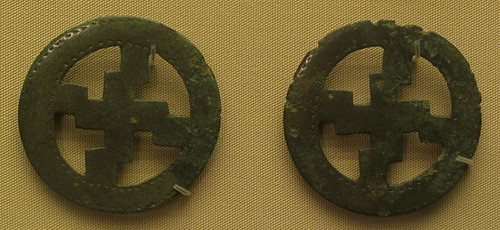
The hammer pendants found often include a large ring on the end of the shaft, this is taken to being a representation of a rope quoit used to whirl the hammer before throwing. This whirling of the hammer in battle may be the reason why hammer wielding gods have a hooked cross as their symbol. When early hooked crosses are looked at in negative, that is to say we examine the space between the legs of the cross not the cross itself, we see four hammers of a similar shape to the axe-hammer above spinning around a central point. (image: http://farm4.static.flickr.com/3583/3798583623_c3634fdacf.jpg) The Sutton Hoo hammer is unique in that it has an iron shaft, this shaft terminates with a small ring which may have been used to attached a rope for whirling.
Overall the hammer is a low status weapon, maybe an improvised weapon, with the exception of the Sutton Hoo royal hammer. The professional armies of raiders and noblemen carried swords, the lower ranks of the shield wall bore spears, hammers and axes, an anything else they could lay their hands on to kill the man in front of them.
]]>Also, I do seem to recall from history classes that smiths, when they were drawn into battle (which was rare, because their skills were too valuable to risk losing), would use their hammer as a personal weapon–which would make sense, as they wielded a hammer all day, it would be a natural choice. Much like farmers would use flails and bill-hooks (the forerunner of the polearm).
Could be wrong on that.
The warhammer didn’t become a popular weapon until the advent of plate armour, where a crushing weapon was far more effective that a cutting or stabbing one.
]]>Edit: thanks Noddy 🙂
]]>I was thinking maybe they had found a war hammer in one of the burial ship in Europe.
]]>